Engineering the Future of Foundry Automation
Engineer smarter casting finishing with automated grinding, precisely controlled machine movement and application-specific fettling solutions.
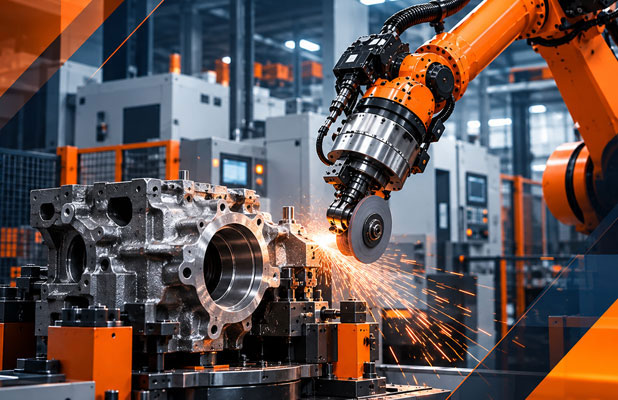
Precixis Pvt. Ltd. is an engineering and industrial automation company focused on developing practical, reliable and innovative fettling solutions for foundry industry. We combine mechanical engineering, robotics, motion control, automation and application-specific engineering to develop machines that address real foundry challenges.
Our solutions are designed around your casting geometry, production requirements and desired finish helping reduce manual dependency and achieve more consistent, repeatable fettling operations.
Discover PrecixisAutomating One of the Most Challenging Processes in Foundry Manufacturing. Fettling is traditionally a highly manual operation involving grinding, cutting and removal of excess material from castings. Precixis brings robotics and intelligent motion control to this process. Our Automatic Fettling Machine is designed to automate casting fettling operations with controlled robotic movement, programmed grinding paths and application-specific process control. Designed to Reduce Manual Dependency.
A single automated system can perform operations that may otherwise require multiple operators, depending on the casting, process and production requirements. Built Around Your Casting. Every foundry application is different. That's why Precixis develops the fettling process around the customer's casting, production requirements and desired finish.
Precixis integrates mechanical systems, servo motion, multi-axis movement and process control to develop automatic fettling machines around specific casting applications.
Choose 4 or 5 axes to suit your needs. The 4-axis model rotates the arm for better access; the 5-axis model also rotates the grinding wheel to reach complex surfaces.
Create and store casting-specific programs for repeat production. Teach points define the grinding path for each component.
The system monitors grinding load and adjusts movement and speed when resistance or excess material is detected.
Every solution is configured to suit the casting, tooling, movement, and fettling requirements.
Precixis automatic fettling machines are designed to automate selected grinding and excess-material removal tasks on suitable cast components.
Grinding and removal of gates and attached excess material.
Removal of excess material around defined riser areas.
Controlled grinding along suitable parting lines to remove flash and excess material.
Automated removal from defined areas according to the programmed process.
Programmed grinding along selected casting profiles.
Access to multiple surfaces using a suitable 4-axis or 5-axis configuration.
Stored programs support repeat processing of validated casting designs.
The operations that can be automated depend on casting geometry, material, tool accessibility, grinding requirements and the desired finish.
An Automatic Fettling Machine is an automated system designed to grind and remove excess material from cast components using controlled and repeatable machine movements.
Suitable casting types depend on component geometry, size, weight, grinding locations and material removal requirements. Precixis offers configurations for rotational, complex, irregular and larger castings.
Machine selection depends on casting dimensions, geometry, grinding locations, tool accessibility, required axis movement and production needs. Our engineering team evaluates these factors before recommending a suitable configuration.
Yes. Different component programs can be created and saved for repeat production. Teach-point based programming allows machine movements and process parameters to be configured for specific applications.
Not necessarily. Operators with CNC/VMC experience can learn machine operation and programming. Training can be provided during installation and commissioning according to the machine configuration.
Yes. Precixis can evaluate application-specific requirements and develop suitable automation solutions based on casting geometry, production volume and process requirements. You can share drawings, 3D models or component photographs for an initial application evaluation.